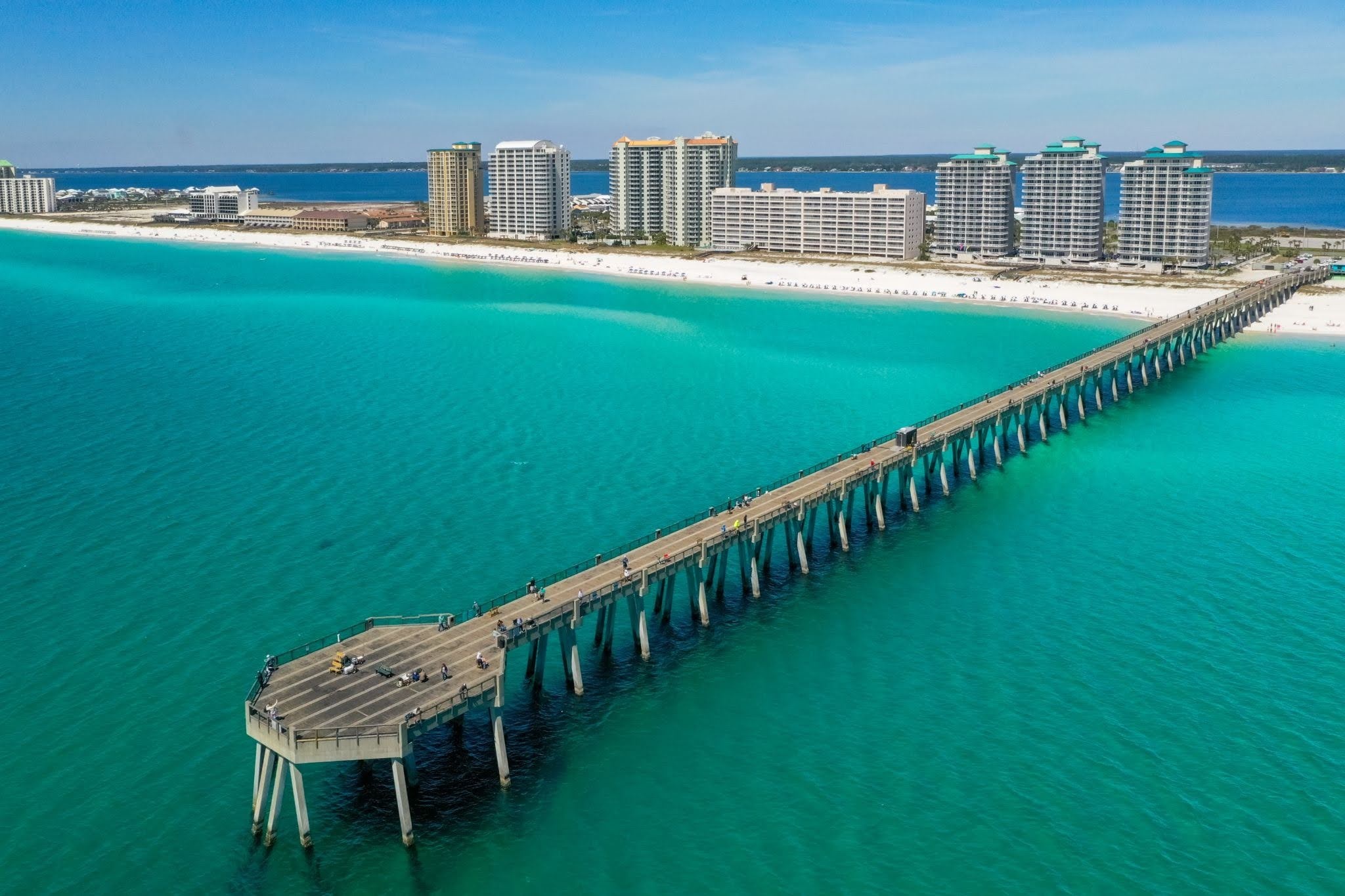
Every write-up about Navarre Beach Fishing Pier leads with the same fact: at 1,545 feet, it is the longest pier in Florida. True, and worth mentioning. But the length is not the only reason to walk it.
The pier is an artificial reef
Drive pilings into a sandy Gulf bottom and you change the ecosystem. Baitfish stack up around the structure for cover, and everything that eats baitfish swings through to check it. The pier functions as a 1,545-foot artificial reef, which makes it a magnet on the daily commute of nearly everything moving along this stretch of the Gulf. Turtles, rays, and dolphins are not living under the pier. They are passing under it, all day, and the deck puts you directly over the traffic.
Walk-on admission for spectators is $1.
What you actually see
Sea turtles. Three species pass through regularly: greens, loggerheads, and the smaller Kemp’s ridley. They cruise the pilings and surface for air in the clear water, often close enough to count the scutes on their shells.
Loggerheads are the crowd favorite for a simple reason: they are big, and from 30 feet up you appreciate every inch. On the right day you can watch one feed on jellyfish directly below you, a full meal in real time that no aquarium recreates. The jellyfish themselves are part of the show. From overhead you can pick out different stages of their life cycle drifting through the clear water, which leads to a counterintuitive local tip: a purple flag on the beach, the warning for dangerous marine life, is actually a good sign for pier watchers. Jellyfish in the water means the buffet is open, and the turtles show up to eat.
Green turtles are the ones grazing rather than hunting. Adults are the only sea turtle that eats a mostly plant diet, working seagrass and algae, and they are the largest hard-shelled sea turtle in the world. The name comes from the color of the fat under the shell, not the shell itself, which throws people who are trying to identify one from above.
The Kemp’s ridley is the rare one. It is the most endangered sea turtle in the world, and for decades it was a genuine scientific mystery: nobody could figure out where they nested, until researchers uncovered old film of tens of thousands of them coming ashore at once on a single stretch of beach in Mexico. That mass synchronized nesting, called an arribada, is a behavior almost no other turtle shares. Spotting one from the pier rail means seeing an animal most marine biologists never see in the wild.
Rays. A whole variety passes under the pier, and some of them are far bigger than people expect. Devil rays move through from roughly August into November, winged animals in the Mobula family that can reach wingspans around 4 feet and often travel in groups near the surface. Spotted eagle rays are the showstoppers: dark backs covered in white spots, long whip tails, and wingspans that commonly run 5 to 7 feet, with the biggest pushing 10 feet and several hundred pounds. Watching one glide over white sand from directly above is one of the most beautiful sights on this coast. Add schools of cownose rays flying in formation and southern stingrays working the bottom, and there is almost always something winged in the water.
Dolphins. Bottlenose dolphins hunt the bait schools the pier concentrates. On a good morning you can watch them herd fish against the structure from directly overhead.
Birds. The wildlife show is not all underwater. Great blue herons stand on the rails and the deck itself, and you can get within feet of a bird most people only see across a marsh. Locals lovingly call every one of them Fred. Up close, a great blue heron is a magnificent animal, four feet of patient predator standing eye level with you, and the reason Fred tolerates the company is simple: he wants the fishermen’s fish. The herons have learned that anglers mean bait scraps and undersized throwbacks, so they work the pier like regulars.
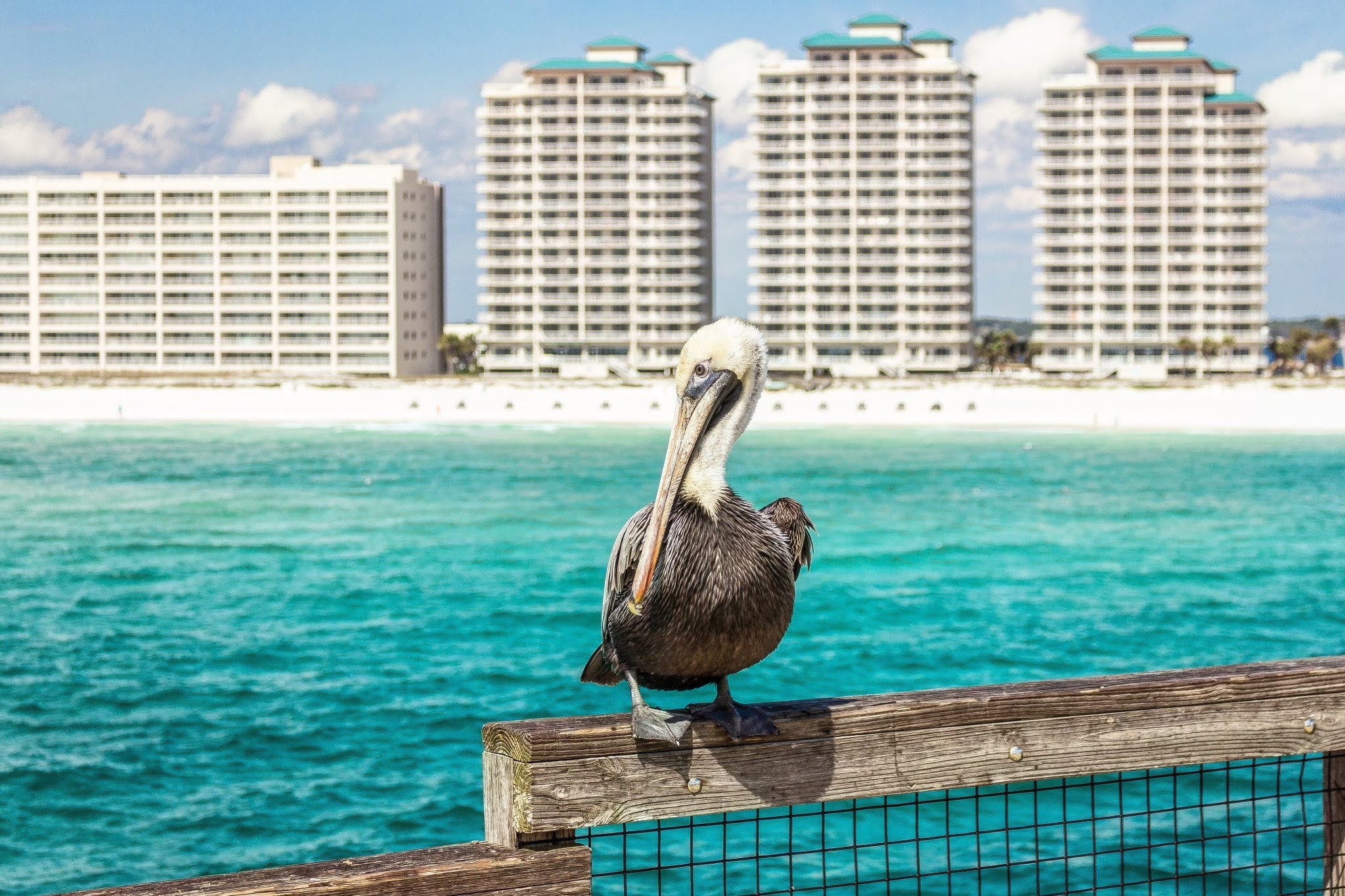
The rest of the birding is genuinely good. Ospreys patrol overhead and hit the water for their own catches. Brown pelicans glide the rail line in formation. Gulls and terns rotate through the sky above the deck. And down on the shore below, plovers and sandpipers work the wet sand in fast little groups, which means you can cover wading birds, raptors, seabirds, and shorebirds from a single 1,545-foot walk.
Fish: The anglers Fred is shadowing are pulling up a genuine variety themselves: Spanish and king mackerel, pompano, redfish, sheepshead, flounder, ladyfish, bonito, and in spring the cobia run that brings crowds to the rail. Part of the fun of a nature walk out here is that it can interrupt itself. You are strolling along watching the water and suddenly a rod bends over three feet away, a crowd gathers, and someone is fighting a big fish right next to you. Sometimes it is a shark, and the whole pier leans in to watch it come up. Even if you never wet a line, what comes over the rail is its own rotating exhibit.
The fishing is excellent. The length is a fun fact. But for a dollar, Navarre Pier might be the best nature-viewing deal on the Emerald Coast.